
WHA Letter to Chairs and Ranking Members on NDAA Priorities

The Honorable Jack Reed                                                    The Honorable Roger Wicker
728 Hart Senate Office Building                                         425 Russell Senate Office Building
U.S. Senate                                                                              U.S. Senate
Washington, DC 20510                                                         Washington, DC 20510

The Honorable Mike Rogers                                                The Honorable Adam Smith
2469 Rayburn House Office Building                                 2264 Rayburn House Office Building
U.S. House of Representatives                                            U.S. House of Representatives
Washington, DC 20515                                                         Washington, DC 20515

To the Chairs and Ranking Members:

For more than 60 years, the National Defense Authorization Act (NDAA) has been a model of bicameral, bipartisan lawmaking. As our country faces extraordinarily complex national security challenges, from Ukraine to Taiwan and in the realms of cyberspace and artificial intelligence, the world once again looks to us for leadership. This defense bill is essential to our success in meeting those challenges, defending the homeland, and supporting our warfighters and their families.

Central to that mission, With Honor Action is advocating for the inclusion of these four priorities in the final version of this year’s National Defense Authorization Act.

  • S. 903 – Department of Defense Civilian Cybersecurity Reserve Act
    • Incorporated as Senate NDAA, Sec. 1216 – Civilian Cybersecurity Reserve pilot project
  • H.R. 2597/S. 1095 – Reserve Component Parental Leave Parity Act
    • Incorporated as House NDAA, Sec. 601 – Parental leave parity for members of certain reserve components of the Armed Forces
  • House NDAA, Section 1118 – Including military service in determining family and medical leave eligibility for federal employees under the Family and Medical Leave Act (FMLA) of 1993
  • S. 2678 – Outbound Investment Transparency Act of 2023
    • Incorporated as Senate NDAA, Sec. 1085 – Protection of covered sectors

As you work to finalize this bill, we appreciate your consideration of the above provisions and respectfully request they be retained in the final draft. We are grateful for your leadership, the dedication of the Members to our national security, and the diligence of your staff members.


Appendix: Further Information

  • S. 903 – Department of Defense Civilian Cybersecurity Reserve Act
    • Incorporated as Senate NDAA, Sec. 1216 – Civilian Cybersecurity Reserve pilot project

Modeled upon the recommendations of the Cyberspace Solarium Commission and the National Commission on Military, National, and Public Service, this provision would create a pilot program to recruit qualified cybersecurity professionals to supplement the federal workforce. Led by For Country Caucus Founding Co-Chair Rep. Jimmy Panetta in the previous Congress, the provision tasks the Department of the Army to establish a pilot program where they may appoint up to 50 reservists drawn from private industry with demonstrated cybersecurity expertise.

  • H.R. 2597/S. 1095 – Reserve Component Parental Leave Parity Act
    • Incorporated as House NDAA, Sec. 601 – Parental leave parity for members of certain reserve components of the Armed Forces

Led by For Country Caucus members Reps. Zach Nunn and Jeff Jackson, the Reserve Component Parental Leave Parity Act would align National Guard and Reserve parental leave eligibility with active duty standards. Under current policy, only birthing mothers are eligible for parental leave– this provision would expand leave eligibility to include fathers and adoptive parents. 

  • House NDAA, Section 1118 – Including military service in determining family and medical leave eligibility for federal employees under the Family and Medical Leave Act (FMLA) of 1993

Led by For Country Caucus member Rep. Chrissy Houlahan, and in partnership with the Bipartisan Policy Center, this provision would allow military service time to count towards the 12-month eligibility requirement for federal employees to receive benefits under FMLA. 

  • S. 2678 – Outbound Investment Transparency Act of 2023
    • Incorporated as Senate NDAA, Sec. 1085 – Protection of covered sectors

This would require U.S. firms to notify the Treasury Department of certain investments in countries of concern while protecting confidential business information. Covered investments include joint ventures, know-how and greenfield investments in certain sectors including advanced semiconductors and microelectronics, artificial intelligence, quantum technology, satellite-based communications, dual-use network laser scanning systems and hypersonics.

With Honor Action to Congress: Support Bipartisan NDAA Priorities

WASHINGTON, D.C. — Today, With Honor Action sent a letter to the Chairs and Ranking Member of the House and Senate Armed Services Committees, calling for the inclusion of four key legislative priorities in the final National Defense Authorization Act (NDAA).

“For over 60 years, the National Defense Authorization Act has been the cornerstone of our national security,” said Rye Barcott, CEO and Co-Founder of With Honor Action. “We hope to see our common sense bipartisan solutions, which focus on military quality of life, cybersecurity and emerging technology, included in the final passage of the bill. Our national security is too important for partisanship.”

With Honor Action is advocating for the inclusion of the following four bipartisan priorities in the final version of this year’s NDAA, some of which are being led by members of the For Country Caucus.

  • S. 903 – Department of Defense Civilian Cybersecurity Reserve Act 
    • To create a pilot program to recruit qualified cybersecurity professionals to supplement the federal workforce. 
  • H.R. 2597/S. 1095 – Reserve Component Parental Leave Parity Act
    • To align National Guard and Reserve parental leave eligibility with active duty standards. Under current policy, only birthing mothers are eligible for parental leave– this provision would expand leave eligibility to include fathers and adoptive parents. 
  • House NDAA, Section 1118 – Including military service in determining family and medical leave eligibility for federal employees under the Family and Medical Leave Act (FMLA) of 1993
    • To allow military service time to count towards the 12-month eligibility requirement for federal employees to receive benefits under FMLA. 
  • S. 2678 – Outbound Investment Transparency Act of 2023
    • To require U.S. firms to notify the Treasury Department of certain investments in countries of concern while protecting confidential business information.

The NDAA is a critical piece of legislation that has historically passed by large, bipartisan margins and sets annual priorities for defending the homeland and arming our warfighters. It addresses challenges at home and abroad, including combatting Russian aggression in Ukraine, deterring Chinese encroachment on Taiwanese sovereignty, and developing new capabilities in the realms of cyberspace and artificial intelligence.

***Read the full letter here, detailing With Honor Action’s four major priorities.

With Honor Action’s Bipartisan Priorities in the 2023 National Defense Authorization Act

CHARLOTTE, NC – With Honor Action works alongside the For Country Caucus, a bipartisan group of 26 veteran Representatives, and a number of bipartisan Senators. Together we fight polarization in Congress, passing legislation focused on national security, national service, and veterans affairs.

With Honor Action advanced the 22 pieces of bipartisan legislation below in this year’s National Defense Authorization Act (NDAA).

We are pleased the NDAA has passed both chambers of Congress for a 62nd year in a row and remains one of the only reliable pieces of annual legislation. However, we are disappointed that the bill failed to include a number of key priorities. For the second straight year, a deviation from regular order resulted in important bipartisan legislation being cut with little or no discussion from the final law. Notably, the NDAA failed to assist our Afghan allies evacuated to the United States last year and those trapped and at risk in Afghanistan.

1)Department of Defense Cyber & Digital Service Academy [Sec. 1535]

A key recommendation from the National Security Commission on Artificial Intelligence (AI), the DoD Cyber and Digital Academy establishes a scholarship-for-service program for students pursuing tech-related programs with a mandatory service requirement in the Department of Defense. This legislation will help build stronger technical talent that helps our military modernize and better prepare for the sweeping technological advancements we face in AI and other areas.

2)Junior Reserve Officers’ Training Corps Expansion Act [Sec. 519A]

JROTC provides invaluable leadership training and civic education to tens thousands of young Americans across the nation. Initiated as a recommendation from the National Commission on Military, National Service, and Public Service, this act tasks the Secretary of Defense with expanding the number of JROTC units and developing a plan that would ensure greater access in rural, low-income, and historically underserved communities.

3)Expansion of Eligibility to Serve as Instructors in the JROTC [Sec. 512]

Current law states that JROTC instructors must be military retirees. This provision addresses the JROTC instructor shortage by expanding eligibility to servicemembers that have served at least eight years and received an honorable discharge.

4)Modification to Annual Report on Military & Security Developments Involving the Russian Federation [Sec. 1243]

The For Country Caucus has been among the most active bipartisan bodies in Congress engaged on Russian aggression and Ukrainian assistance and oversight. The Russian invasion of Ukraine presents the United States a unique opportunity to study the strategic and operational strengths and weaknesses of a rival military. This provision tasks the Department of Defense with developing an assessment to be submitted to Congress.

5)Sense of Congress on Taiwan Defense Relations [Sec. 5512]

Expresses the sense of Congress that Taiwan’s future will be determined by peaceful means, not Chinese force, and that the United States should continue to support the development of capable and modern Taiwanese defense forces that are prepared to repel a Chinese assault.

6)Report on the Prevalence of Adverse Childhood Experiences for Servicemembers [House, Directive Report Language]

Directs the Secretary of Defense to conduct a study of the prevalence of Adverse Childhood Experiences (ACEs). An ACE is a potentially traumatic event that occurs between the ages of 0 and 17. ACEs are one of the most significant risk factors for suicide and future mental and physical health crises, among service members.

7)Demonstration Project on Infant and Early Childhood Mental Health Services for Children of the Armed Forces [Directive Report Language]

Directs the Secretary of Defense to brief the Committees on Armed Services on the adequacy and availability of mental health services for children of military personnel with mental health needs.

8)Annual Report on Members Separating from the Active Duty Who File Claims for Disability Benefits [Sec. 563]

The U.S. has an obligation to acknowledge service-related disabilities. This provision requires the Secretary of Defense to submit a report which details the number of Armed Service members who have filed claims for disability benefits since 2019. The report must include how these claims were handled, when the claim was submitted relative to their discharge date from active duty, and whether a mental health check was completed.

9)DHS Roles & Responsibilities in Cyberspace Act [Sec. 7124]

Tasks the Secretary of the Department of Homeland Security with conducting a review of its incident response plans and sets the conditions for improvements to our cyber incident response framework.

10)Support for R&D of Bioindustrial Manufacturing Processes [Sec. 215]

Bioindustrial manufacturing is a nascent but exciting form of manufacturing that uses living organisms, cells, tissues, or enzymes, to produce materials that are both more environmentally sustainable and create a more resilient supply chain. This provision authorizes the Secretary of Defense to strengthen our bioindustrial manufacturing infrastructure through the creation of regional bioindustrial networks. This expansion will keep bioindustrial manufacturing in the U.S., securing supply chains essential to the production of critical chemicals and materials.

11)Supporting Education Recognition for Veterans During Emergencies (SERVE) Act [Sec. 5127]

Tasks the Department of Veterans Affairs with creating an online database of veterans who self report service-connected medical training. In moments of healthcare crises, this database will allow for the VA to call on these veterans for assistance.

12)Post-Widow’s Tax Repeal Survivor Benefits Plan Open Enrollment for Service-Disabled Veterans Act [Sec. 643]

In the 116th Congress, members of the For Country Caucus successfully repealed what was dubbed as the “Widow’s Tax.” The “Widow’s Tax” required surviving spouses who received a Dependency and Indemnity Compensation to pay a dollar-for-dollar offset from their Military Survivor Benefit Plan. Although the repeal helped many families, nearly 1,600 service-disabled veterans had withdrawn from the benefit plan and stopped paying premiums. This provision creates a special open enrollment period for this targeted veteran population, allowing them to re-enroll, catch up on any missed premiums, and collect the benefits.

13)Increases in Maximum Allowable Income for Purposes of Eligibility for Basic Needs Allowance [Sec. 611]

Addressing unacceptably high levels of food insecurity among working-age active duty, the legislation increases eligibility for the Basic Needs Allowance , raising eligibility from household incomes that fall below 130% federal poverty guidelines to 150%, and allows the Secretary of Defense to increase eligibility threshold to 200% for specific cases.

14)Requirements to Reduce Out-of-Pocket Costs of Members of the Armed Forces for Uniform Items [Sec. 390]

Directs the Secretary of Defense to track out-of-pocket costs for uniforms. The findings will be used to develop an appropriate uniform replacement allowance for officers of the Armed Forces.

15)Fairness for Federal Firefighters [Sec. 5305]

Many federal firefighters are veterans, which prompted With Honor Action and members of the For Country Caucus to champion this legislation. The law intends to help an estimated 10,000 federal firefighters receive the same access to job-related disability and retirement benefits as state, county, and municipal firefighters by creating a presumption of service-connected disabilities stemming from serious diseases.

16)Treatment of Personally Identifiable Information Regarding Prospective Recruits [Sec. 531]

This law strengthens the privacy safeguards surrounding the collection of Personally Identifiable Information in military recruitment. It authorizes the Secretary of Defense to establish the Military Recruiting Modernization Program as a pilot program to evaluate the usage of more modern technologies in handling personally identifiable information.

17)Short Course on Emerging Technologies for Senior Officials [Sec. 9507]

This provision, a priority of both the Cyberspace Solarium Commission and a recommendation of the National Security Commission on Artificial Intelligence, directs the Secretary of Defense to develop a short course addressing how recent technological advances affect the Defense Department.

18)Improvements to Principal Cyber Advisors [Sec. 1501]

Codifies the offices and roles of the Principal Cyber Advisors. It also authorizes the PCA to the Secretary of Defense to certify portions of the Department’s Cyberspace Activities Budget.

19)Cybersecurity Grants for Schools [Sec. 7104]

With cyberattacks targeting schools on the rise, this provision increases funding for K-12 cybersecurity education, both for educators and students.

20)Cyber Diplomacy Act [Sec. 9502]

In April 2022, Secretary of State Antony Blinken announced the creation of a Bureau of Cyberspace and Digital Policy to address “the national security challenges, economic opportunities, and implications for U.S. values associated with cyberspace, digital technologies, and digital policy.” Section 9502 codifies the Secretary’s announcement. This bureau will be led by the first-ever U.S. Ambassador-at-Large for Cyberspace and Digital Policy Nathaniel Fick, a Marine who served formerly on the With Honor Action Advisory Board.

21)Enhancing Maritime Cybersecurity [Sec. 11224]

Cyber attacks on the maritime ports increased by 400% in 2020. This provision tasks the Commandant of the Coast Guard and relevant cybersecurity agencies with developing a list of tools and resources open to the public designed to assist maritime operators in identifying, responding to, and recovering from cyber incidents.

22)Baltic Reassurance Act [Sec. 1272]

Directs the Department of Defense to continue its comprehensive Baltic Defense Assessment, specifically focusing on interactions between Estonia, Latvia, and Lithuania with NATO. This will be done in an effort to improve resistance to cyber aggression by the Russian Federation.

With Honor Action Applauds and Encourages Inclusion of ECA

CHARLOTTE, NC – With Honor Action applauds the potential inclusion of the Electoral Count Reform Act of 2022 (ECA) in a forthcoming FY23 Omnibus Appropriations bill. S.4573 – The Electoral Count Reform Act of 2022 enjoys broad bipartisan support in both the House and Senate. If passed, this landmark legislation would reform and modernize an outdated, 19th century law that establishes procedures for counting electoral votes. In addition to updating old Electoral College rules, the ECA would specify the Vice President’s role as purely ministerial and protect each states’ popular vote.

“The work members are putting in across party lines to ensure a healthy separation of powers is incredibly encouraging,” said Rye Barcott, CEO and Co-Founder of With Honor Action. “The ECA is uncontroversial and represents simple good governance. I hope to see it included in the final appropriations bill.”

For further information on the ECA, please refer to this one-pager shared by the bill’s lead sponsor Senator Susan Collins of Maine. Other co-sponsors include military veterans and U.S. Senators Todd Young of Indiana and Mark Kelly of Arizona.

With Honor on Initial 2022 General Election Results for Veterans and Polarization

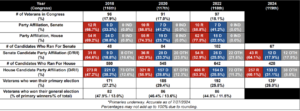
CHARLOTTE, NC – The 2022 midterms saw another surge of veteran candidates running to serve again across party lines. 744 veterans ran for Congress (190 D, 457 R, 97 I), a 18% increase from the prior cycle. Veterans running who served after September 11th increased by 29.4%. This is an encouraging trend.

With Honor has worked with more than two dozen veterans in Congress who took the pledge to serve with integrity, civility, and courage, and participate in the bipartisan For Country Caucus. This group has passed more than 50 laws in four years, including 23 in 2021. With Honor projects the number of U.S. Representatives committed to this pledge will increase by more than 10% as the final results come in from the 2022 midterms.

The total number of veterans in Congress will increase modestly. The current number of veterans in the Senate will hold at least constant at 16, or possibly increase by 1-2% depending on the outcomes of the senate races in Nevada and Arizona.

With Honor is projecting that the percentage of veterans in the House will increase modestly. 230 veterans advanced to the general election in the House (59 Democrats, 120 Republicans, 51 Independents). At the time of this press release, 77 races with veterans have been called in the House and 21 races with veteran candidates are still too close to call.

“I’m grateful to With Honor for helping more principled veterans get elected to Congress who will participate in the bipartisan For Country Caucus. That is making a big impact and pushing against the polarization threatening our Republic,” said U.S. Congressman Don Bacon, a retired Air Force Brigadier General and co-chair of the For Country Caucus who won re-election in Nebraska’s 2nd District.

“It’s inspiring to see so many principled veterans who won last night and are committed to serving across party lines in the For Country Caucus,” said U.S. Congressman Jason Crow, an Army Ranger and veteran of the wars in Iraq and Afghanistan and founding member of the For Country Caucus, who was re-elected last night in Colorado’s 6th District. “It is possible to break through our polarized, cynical politics, and get things done. These are some of the Americans doing it, and I look forward to working with them.”

With Honor Fund congratulates its endorsed veterans who have won their general elections:

Congressman Mark Amodei (NV-02)

Congressman Jake Auchincloss (MA-04)

Congressman Don Bacon (NE-02)

Congressman Salud Carbajal (CA-24)

Congressman Jason Crow (CO-06)

Congressman-elect Don Davis (NC-01)

Congressman Jake Ellzey (TX-06)

Congressman Mike Gallagher (WI-08)

Congressman Tony Gonzales (TX-23)

Congresswoman Chrissy Houlahan (PA-06)

Congressman-elect Wesley Hunt (TX-38)

Congressman-elect Jeff Jackson (NC-14)

Congressman-elect Nick LaLota (NY-01)

Congresswoman Mariannette Miller-Meeks (IA-01)

Congressman Seth Moulton (MA-06)

Congressman Jimmy Panetta (CA-19)

Congresswoman Mikie Sherrill (NJ-11)

Congressman Michael Waltz (FL-06)

The following With Honor Fund endorsed veterans are in races that have not yet been called:

Mr. Francis Conole (Candidate for NY-22)

Mr. Chris Deluzio (Candidate for PA-17)

Congressman Jared Golden (Candidate for ME-02)

Congressman Pat Ryan (Candidate for NY-18)

Mr. John James (Candidate for MI-10)

Dr. Kermit Jones (Candidate for CA-03)

Additionally, With Honor Fund supported the following principled Americans who served our country in other capacities, specifically federal law enforcement, intelligence, and as civilians in the State Department and Department of Defense.

Congressman Brian Fitzpatrick (PA-01)

Congresswoman Abigail Spanberger (VA-07)

Congressman Andy Kim (NJ-03)

Congresswoman Elissa Slotkin (MI-08)

With Honor Fund endorsed two veterans running in state races for the first time this cycle. Former With Honor Action Advisory Board Member Wes Moore will be the next Governor of Maryland. Former For Country Caucus Member Anthony Brown will be the Attorney General of Maryland.

“Decency won last night in districts across the nation. In a moment of crippling polarization, these results are encouraging,” said Rye Barcott, Co-Founder and CEO of With Honor Action. “Americans recognize the value and promise of veteran candidates who choose to continue to serve this country with a commitment to bipartisanship and the values embodied by the pledge they have taken: integrity, civility, and courage. ”

With Honor congratulates these new and incumbent members on their wins and looks forward to working alongside them to accomplish more for the American people. Please contact us if you would like more information.

Join Us Now

    * Required Field(s)